Zenya
A Simpler Way to Stake, Save & Borrow Crypto
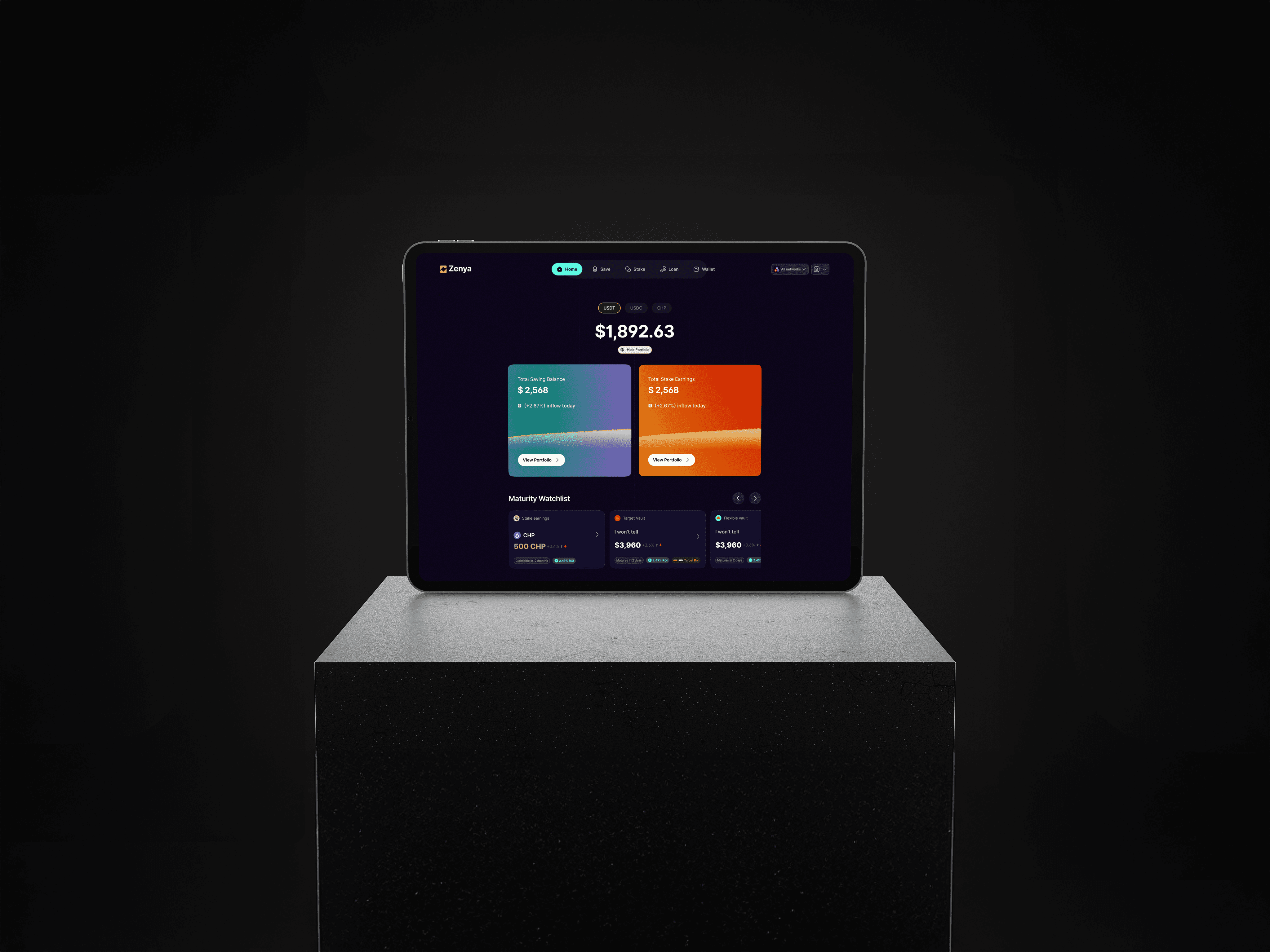
Zenya is a non-custodial DeFi platform that allows users to stake, save, and borrow crypto assets, while maintaining full control. It was designed to simplify the complex DeFi experience with flexible interactions, real-time insights, and transparent terms.
Year
2025
Project Role
Product Designer
Industry
WEB3
Discovery and Purpose
In traditional finance, saving is a culture, you set a goal, lock your funds, and earn steady interest over time. But in crypto, that same sense of stability is surprisingly hard to find. Most users end up holding stablecoins that sit idle in wallets generating no growth.
Existing DeFi solutions tried to address this problem, but most missed the mark. Some focused on speculation, offering high-yield dashboards overloaded with technical jargon that intimidated newcomers. And crucially, there was no cultural equivalent to familiar saving platforms like PiggyVest or Cowrywise, especially for African users eager for both trust and tangible returns.
Reviving Idle Assets
Through research and interviews with everyday crypto users, first-time Web3 adopters, and even those who had “given up” after negative experiences, a clear pattern emerged:
Assets were idle. People wanted returns, but existing platforms felt risky or overly complex.
Liquidity was essential. Users needed quick access to cash without losing their long-term holdings.
Language was a barrier. Terms like “bridging” and “staking” alienated those without deep crypto knowledge.
Trust was fragile. Stories of scams and rug pulls left users skeptical and fearful of participating.
Designing for Confidence, Not Speculation
To bring this vision to life, I teamed up with another designer and we started by building a modular design system.
We believed that if we could design a platform that blended the simplicity of traditional savings apps with the power of DeFi, we could unlock the true potential of stablecoins. The hypothesis was simple:
Make saving intuitive and goal-driven.
Offer flexibility without sacrificing returns.
Build trust through transparency, clarity, and control.
With that perspective in mind, the goal was to turn passive crypto assets into active, growing investments without compromising on user confidence or users needing another crash course on crypto.
Vaults That Match Real-Life Habits
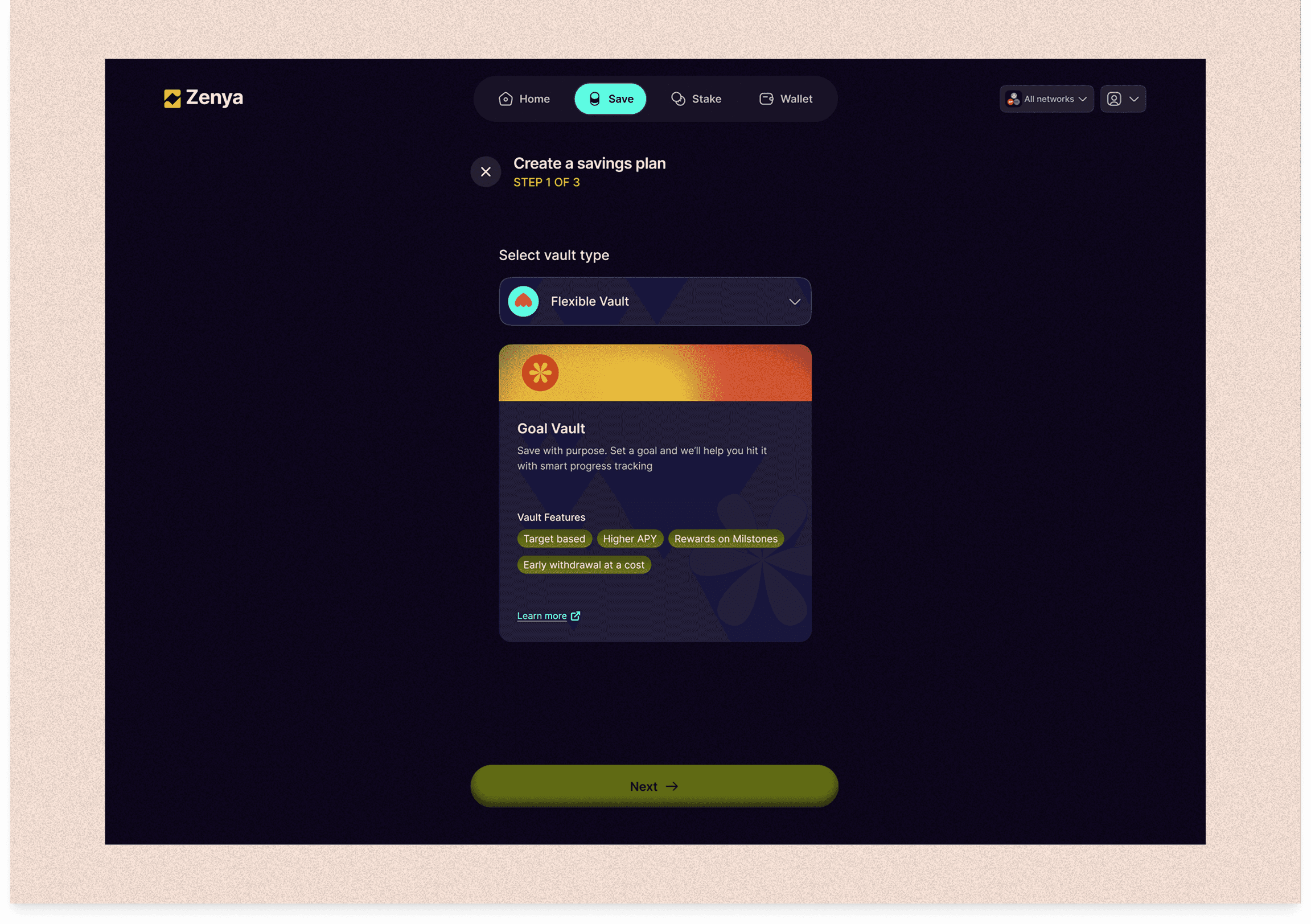
We knew that to make saving feel natural, Zenya had to mirror the way people already manage their money with options that fit different goals, timelines, and levels of commitment.
Flexible Vaults: Designed for everyday needs, these allow users to deposit stablecoins and withdraw them at any time without penalties. It’s ideal for those who value liquidity and want quick access to funds.
Goal-Oriented Vaults: Perfect for planned targets like travel, tuition, or business savings. Users can set a goal amount, track their progress visually, and stay motivated as their balance grows toward that milestone.
Safe Locks: For users focused on maximizing returns, these offer fixed-term savings with higher yields. Funds are locked for a set period, and in exchange, the returns are more rewarding and predictable.

Getting Users Started
For many people stepping into Web3, the biggest barrier isn’t investing, it’s getting started. Most DeFi platforms require users to create new wallets, memorize seed phrases, or migrate assets before they can even explore features, and that complexity often drives them away.
For Zenya we approached onboarding differently. We allowed users to connect with wallets they already know and trust with the likes of Metamask, WalletConnect, Rainbow, and others. The goal of this decision was to remove unnecessary friction, reduce user hesitation, and eliminate the “wallet fatigue” that comes with juggling multiple wallets or repeating onboarding steps.
Rewards Meets Growth
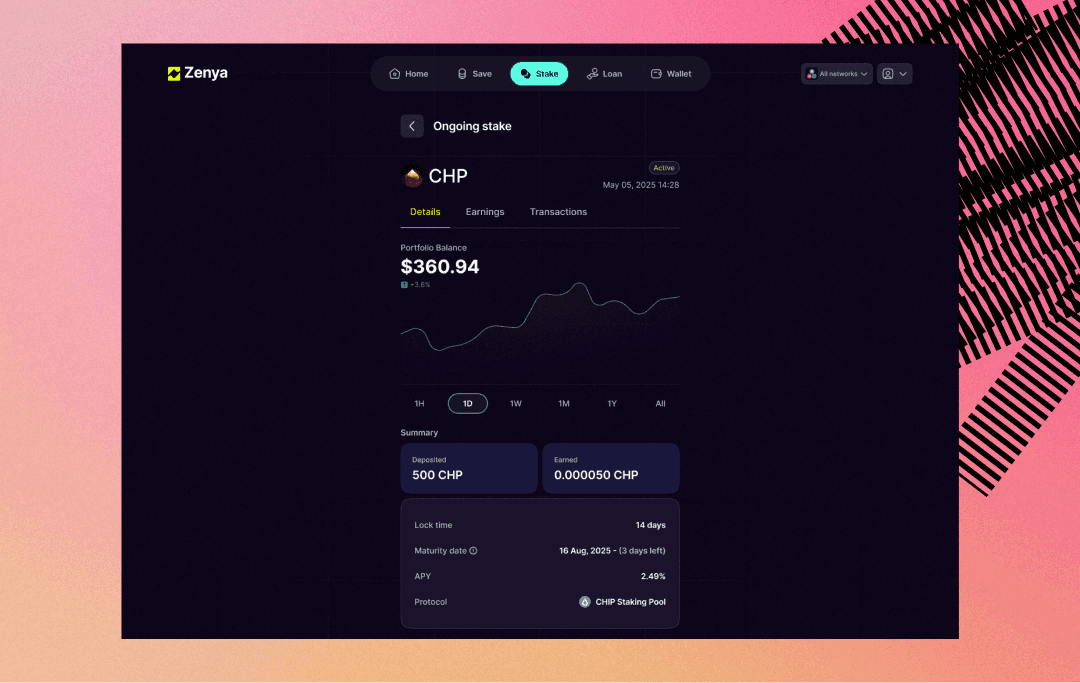
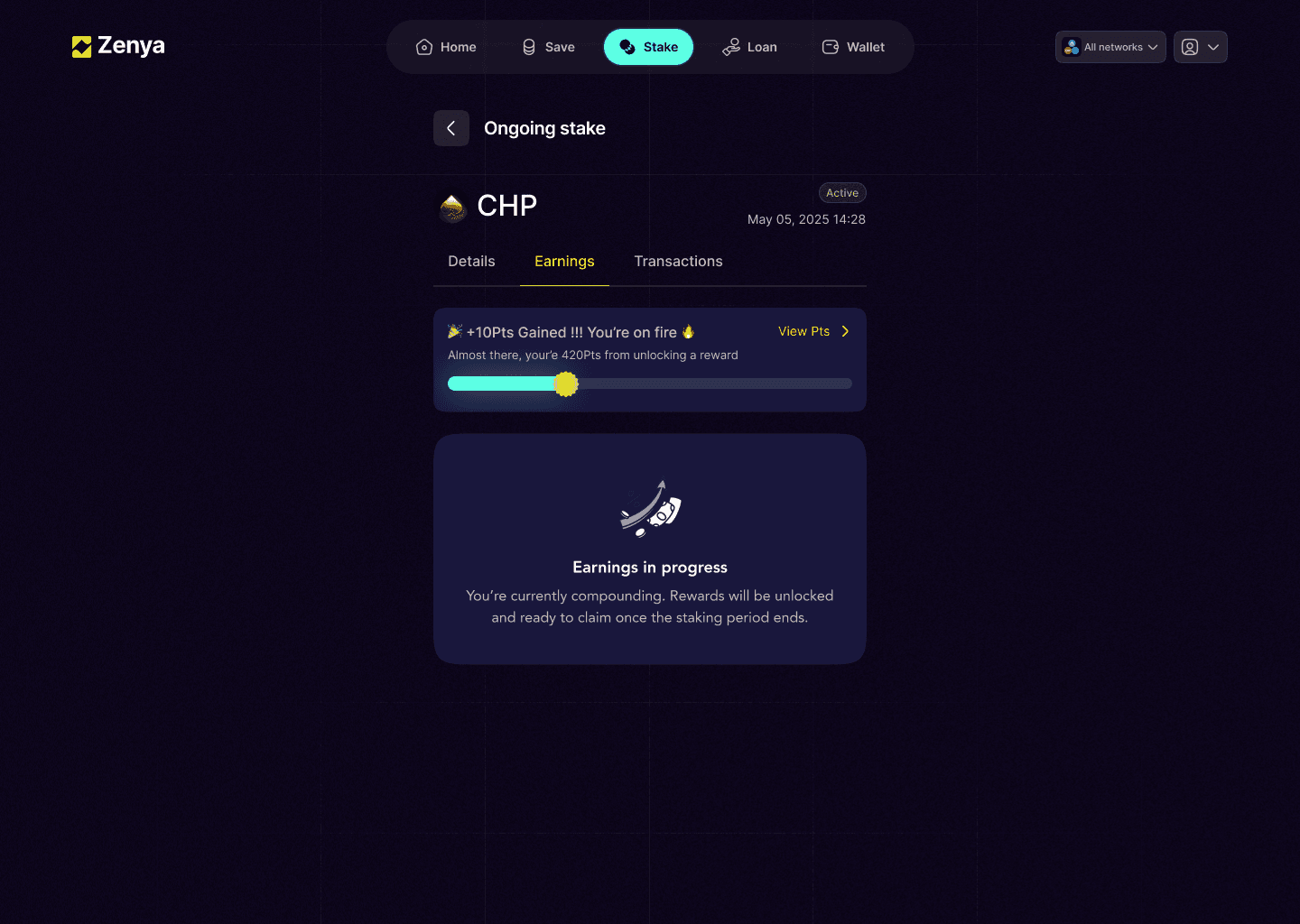
Beyond stablecoins, we designed Zenya to let users stake traditional tokens like ETH, USDT etc. Users weren’t just locking tokens away, they were actively compounding value, earning meaningful rewards without needing to constantly monitor markets or chase risky opportunities.
Extending this philosophy into borrowing as well. Our design reframed borrowing as a guided, confidence-building process and not a gamble. Users could instantly see their borrowing power, preview liquidation thresholds before committing, and monitor repayments in real time.


Turning Skepticism into Trust
Our biggest challenge was overcoming the deep skepticism surrounding DeFi, especially in emerging markets where financial scams have eroded trust. Even with a clear UX, we had to continuously validate our design decisions with users, ensuring that every feature from vaults to borrowing felt transparent and secure.
We also faced the complexity of simplifying inherently technical concepts without oversimplifying them. Balancing clarity and accuracy required multiple design sprints and iterative feedback loops.
From our early testing with prototype we tracked the following outcomes:
Users were confident using stablecoins for staking as part of their financial strategy.
Adoption rates were impressive, with first-time Web3 users citing Zenya's simplicity as their reason for trying the saving vault feature.
Reward to Engagement rationale, thanks to features like NFT-powered badges that rewarded activity, community interest grew steadily, with some badges even holding tradable value.
Redefining Crypto Saving for the Real World
Designing Zenya reinforced a conviction: DeFi doesn't have to be complex, intimidating, or unapproachable. When you lead with trust, transparency, and familiarity, adoption follows.
In a space often driven by speculation, Zenya offered something different , a platform where users could save, grow, and participate in the future of finance on their own terms.

Zenya
A Simpler Way to Stake, Save & Borrow Crypto
Zenya is a non-custodial DeFi platform that allows users to stake, save, and borrow crypto assets, while maintaining full control. It was designed to simplify the complex DeFi experience with flexible interactions, real-time insights, and transparent terms.
Year
2025
Project Role
Product Designer
Industry
WEB3
Discovery and Purpose
In traditional finance, saving is a culture, you set a goal, lock your funds, and earn steady interest over time. But in crypto, that same sense of stability is surprisingly hard to find. Most users end up holding stablecoins that sit idle in wallets generating no growth.
Existing DeFi solutions tried to address this problem, but most missed the mark. Some focused on speculation, offering high-yield dashboards overloaded with technical jargon that intimidated newcomers. And crucially, there was no cultural equivalent to familiar saving platforms like PiggyVest or Cowrywise, especially for African users eager for both trust and tangible returns.
Reviving Idle Assets
Through research and interviews with everyday crypto users, first-time Web3 adopters, and even those who had “given up” after negative experiences, a clear pattern emerged:
Assets were idle. People wanted returns, but existing platforms felt risky or overly complex.
Liquidity was essential. Users needed quick access to cash without losing their long-term holdings.
Language was a barrier. Terms like “bridging” and “staking” alienated those without deep crypto knowledge.
Trust was fragile. Stories of scams and rug pulls left users skeptical and fearful of participating.
Designing for Confidence, Not Speculation
To bring this vision to life, I teamed up with another designer and we started by building a modular design system.
We believed that if we could design a platform that blended the simplicity of traditional savings apps with the power of DeFi, we could unlock the true potential of stablecoins. The hypothesis was simple:
Make saving intuitive and goal-driven.
Offer flexibility without sacrificing returns.
Build trust through transparency, clarity, and control.
With that perspective in mind, the goal was to turn passive crypto assets into active, growing investments without compromising on user confidence or users needing another crash course on crypto.
Vaults That Match Real-Life Habits
We knew that to make saving feel natural, Zenya had to mirror the way people already manage their money with options that fit different goals, timelines, and levels of commitment.
Flexible Vaults: Designed for everyday needs, these allow users to deposit stablecoins and withdraw them at any time without penalties. It’s ideal for those who value liquidity and want quick access to funds.
Goal-Oriented Vaults: Perfect for planned targets like travel, tuition, or business savings. Users can set a goal amount, track their progress visually, and stay motivated as their balance grows toward that milestone.
Safe Locks: For users focused on maximizing returns, these offer fixed-term savings with higher yields. Funds are locked for a set period, and in exchange, the returns are more rewarding and predictable.
Getting Users Started
For many people stepping into Web3, the biggest barrier isn’t investing, it’s getting started. Most DeFi platforms require users to create new wallets, memorize seed phrases, or migrate assets before they can even explore features, and that complexity often drives them away.
For Zenya we approached onboarding differently. We allowed users to connect with wallets they already know and trust with the likes of Metamask, WalletConnect, Rainbow, and others. The goal of this decision was to remove unnecessary friction, reduce user hesitation, and eliminate the “wallet fatigue” that comes with juggling multiple wallets or repeating onboarding steps.
Rewards Meets Growth
Beyond stablecoins, we designed Zenya to let users stake traditional tokens like ETH, USDT etc. Users weren’t just locking tokens away, they were actively compounding value, earning meaningful rewards without needing to constantly monitor markets or chase risky opportunities.
Extending this philosophy into borrowing as well. Our design reframed borrowing as a guided, confidence-building process and not a gamble. Users could instantly see their borrowing power, preview liquidation thresholds before committing, and monitor repayments in real time.
Turning Skepticism into Trust
Our biggest challenge was overcoming the deep skepticism surrounding DeFi, especially in emerging markets where financial scams have eroded trust. Even with a clear UX, we had to continuously validate our design decisions with users, ensuring that every feature from vaults to borrowing felt transparent and secure.
We also faced the complexity of simplifying inherently technical concepts without oversimplifying them. Balancing clarity and accuracy required multiple design sprints and iterative feedback loops.
From our early testing with prototype we tracked the following outcomes:
Users were confident using stablecoins for staking as part of their financial strategy.
Adoption rates were impressive, with first-time Web3 users citing Zenya's simplicity as their reason for trying the saving vault feature.
Reward to Engagement rationale, thanks to features like NFT-powered badges that rewarded activity, community interest grew steadily, with some badges even holding tradable value.
Redefining Crypto Saving for the Real World
Designing Zenya reinforced a conviction: DeFi doesn't have to be complex, intimidating, or unapproachable. When you lead with trust, transparency, and familiarity, adoption follows.
In a space often driven by speculation, Zenya offered something different , a platform where users could save, grow, and participate in the future of finance on their own terms.
Zenya
A Simpler Way to Stake, Save & Borrow Crypto
Zenya is a non-custodial DeFi platform that allows users to stake, save, and borrow crypto assets, while maintaining full control. It was designed to simplify the complex DeFi experience with flexible interactions, real-time insights, and transparent terms.
Year
2025
Project Role
Product Designer
Industry
WEB3
Discovery and Purpose
In traditional finance, saving is a culture, you set a goal, lock your funds, and earn steady interest over time. But in crypto, that same sense of stability is surprisingly hard to find. Most users end up holding stablecoins that sit idle in wallets generating no growth.
Existing DeFi solutions tried to address this problem, but most missed the mark. Some focused on speculation, offering high-yield dashboards overloaded with technical jargon that intimidated newcomers. And crucially, there was no cultural equivalent to familiar saving platforms like PiggyVest or Cowrywise, especially for African users eager for both trust and tangible returns.
Reviving Idle Assets
Through research and interviews with everyday crypto users, first-time Web3 adopters, and even those who had “given up” after negative experiences, a clear pattern emerged:
Assets were idle. People wanted returns, but existing platforms felt risky or overly complex.
Liquidity was essential. Users needed quick access to cash without losing their long-term holdings.
Language was a barrier. Terms like “bridging” and “staking” alienated those without deep crypto knowledge.
Trust was fragile. Stories of scams and rug pulls left users skeptical and fearful of participating.
Designing for Confidence, Not Speculation
To bring this vision to life, I teamed up with another designer and we started by building a modular design system.
We believed that if we could design a platform that blended the simplicity of traditional savings apps with the power of DeFi, we could unlock the true potential of stablecoins. The hypothesis was simple:
Make saving intuitive and goal-driven.
Offer flexibility without sacrificing returns.
Build trust through transparency, clarity, and control.
With that perspective in mind, the goal was to turn passive crypto assets into active, growing investments without compromising on user confidence or users needing another crash course on crypto.
Vaults That Match Real-Life Habits
We knew that to make saving feel natural, Zenya had to mirror the way people already manage their money with options that fit different goals, timelines, and levels of commitment.
Flexible Vaults: Designed for everyday needs, these allow users to deposit stablecoins and withdraw them at any time without penalties. It’s ideal for those who value liquidity and want quick access to funds.
Goal-Oriented Vaults: Perfect for planned targets like travel, tuition, or business savings. Users can set a goal amount, track their progress visually, and stay motivated as their balance grows toward that milestone.
Safe Locks: For users focused on maximizing returns, these offer fixed-term savings with higher yields. Funds are locked for a set period, and in exchange, the returns are more rewarding and predictable.
Getting Users Started
For many people stepping into Web3, the biggest barrier isn’t investing, it’s getting started. Most DeFi platforms require users to create new wallets, memorize seed phrases, or migrate assets before they can even explore features, and that complexity often drives them away.
For Zenya we approached onboarding differently. We allowed users to connect with wallets they already know and trust with the likes of Metamask, WalletConnect, Rainbow, and others. The goal of this decision was to remove unnecessary friction, reduce user hesitation, and eliminate the “wallet fatigue” that comes with juggling multiple wallets or repeating onboarding steps.
Rewards Meets Growth
Beyond stablecoins, we designed Zenya to let users stake traditional tokens like ETH, USDT etc. Users weren’t just locking tokens away, they were actively compounding value, earning meaningful rewards without needing to constantly monitor markets or chase risky opportunities.
Extending this philosophy into borrowing as well. Our design reframed borrowing as a guided, confidence-building process and not a gamble. Users could instantly see their borrowing power, preview liquidation thresholds before committing, and monitor repayments in real time.
Turning Skepticism into Trust
Our biggest challenge was overcoming the deep skepticism surrounding DeFi, especially in emerging markets where financial scams have eroded trust. Even with a clear UX, we had to continuously validate our design decisions with users, ensuring that every feature from vaults to borrowing felt transparent and secure.
We also faced the complexity of simplifying inherently technical concepts without oversimplifying them. Balancing clarity and accuracy required multiple design sprints and iterative feedback loops.
From our early testing with prototype we tracked the following outcomes:
Users were confident using stablecoins for staking as part of their financial strategy.
Adoption rates were impressive, with first-time Web3 users citing Zenya's simplicity as their reason for trying the saving vault feature.
Reward to Engagement rationale, thanks to features like NFT-powered badges that rewarded activity, community interest grew steadily, with some badges even holding tradable value.
Redefining Crypto Saving for the Real World
Designing Zenya reinforced a conviction: DeFi doesn't have to be complex, intimidating, or unapproachable. When you lead with trust, transparency, and familiarity, adoption follows.
In a space often driven by speculation, Zenya offered something different , a platform where users could save, grow, and participate in the future of finance on their own terms.