Your Work Buddy
Bridging Professional Needs with On-Demand Talent
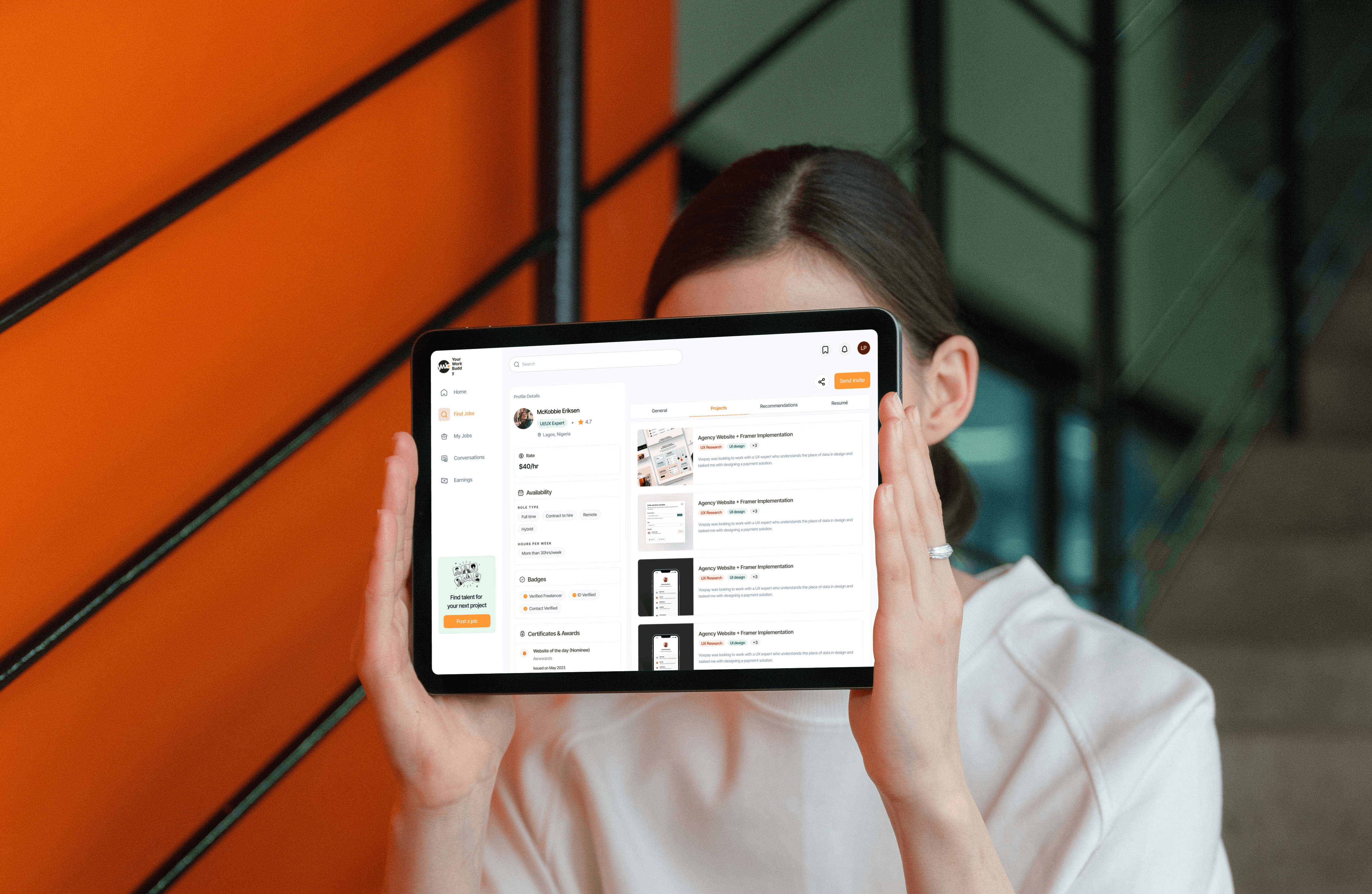
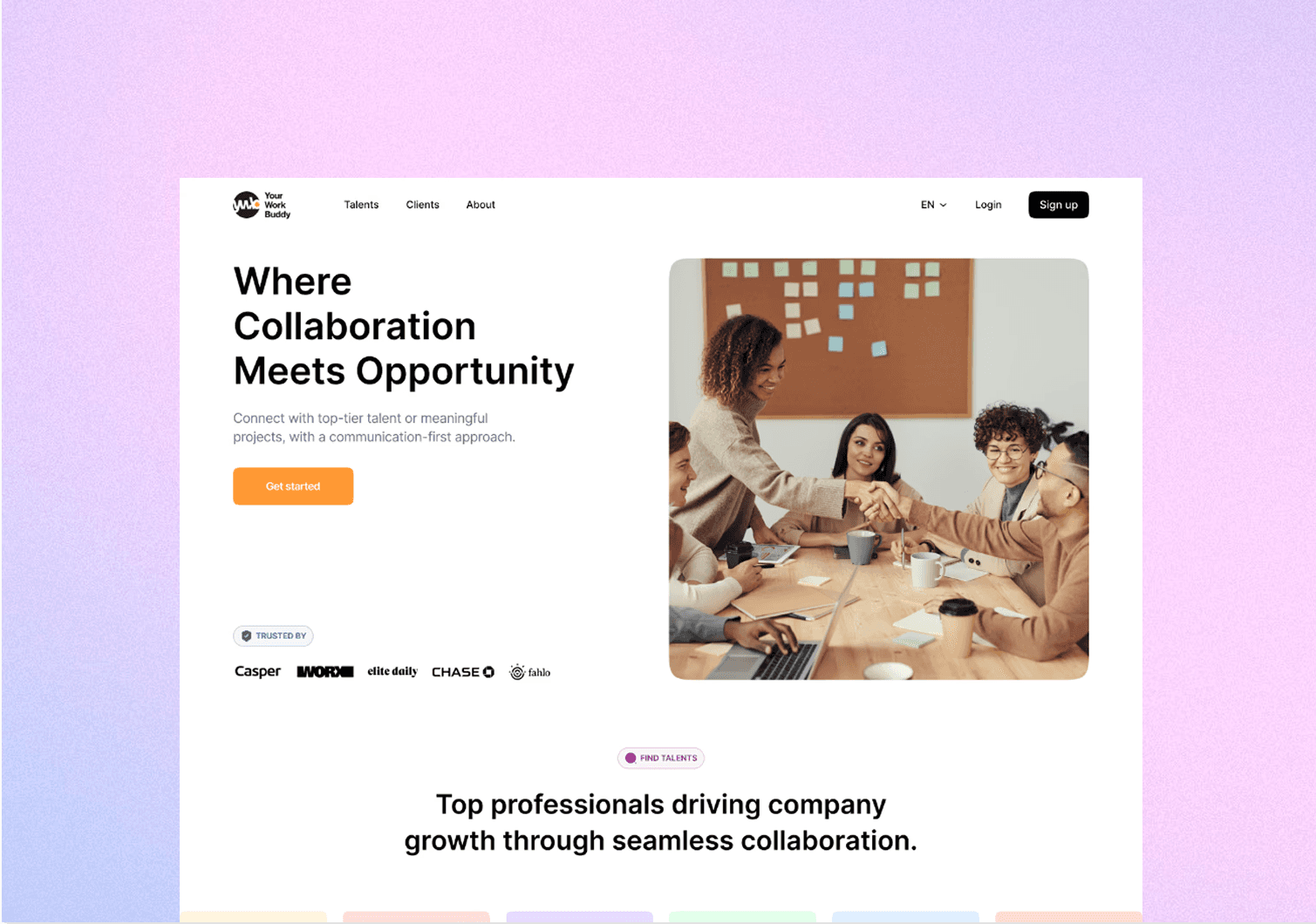
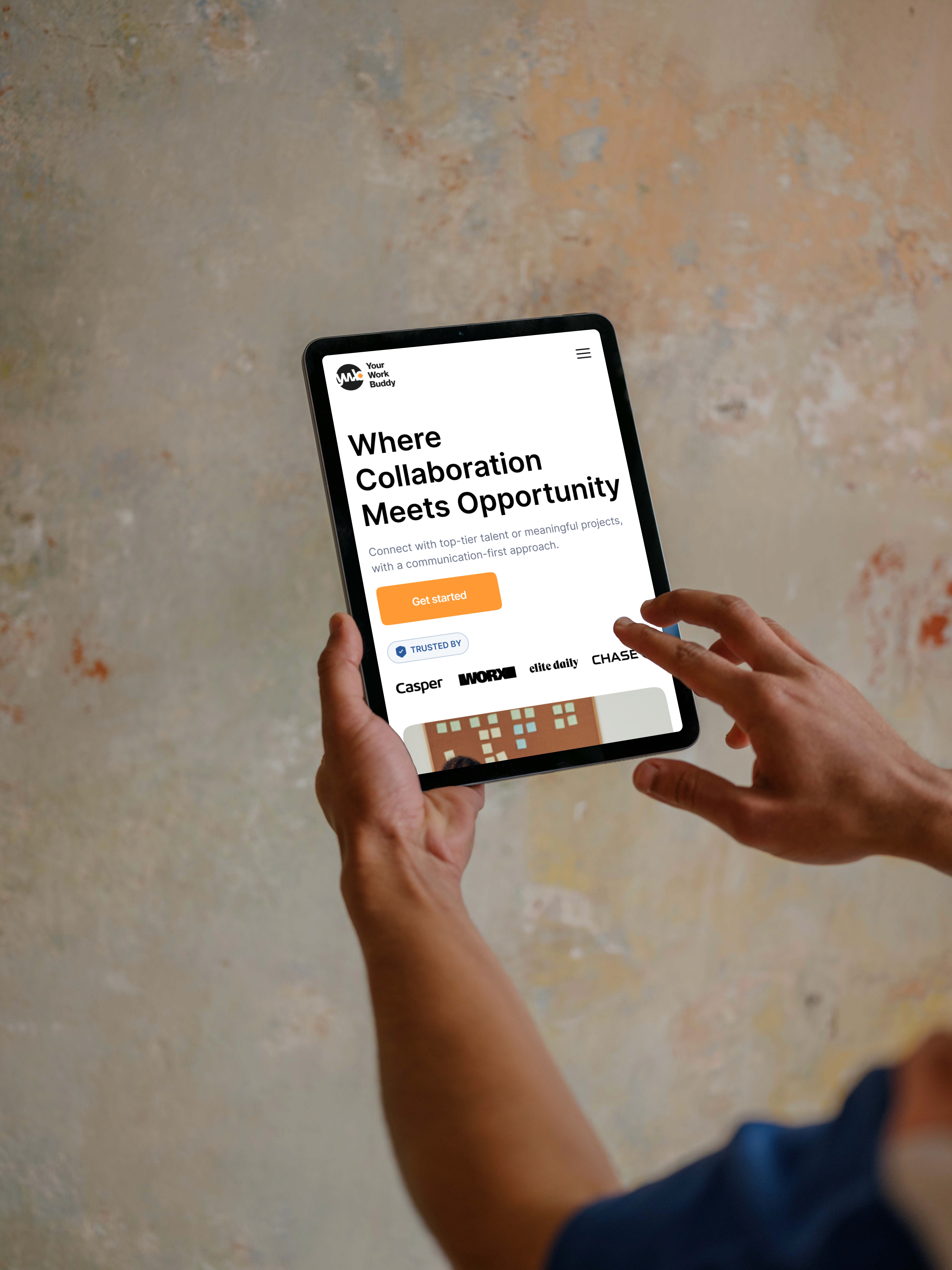
Finding jobs online often feels cold and transactional. YourWorkBuddy’s (YWB) mission was to create a platform that feels like a buddy, someone who smooths the process, reduces friction, and makes work connections feel less daunting.

Year
2025
Project Role
Product Designer
Industry
Job board
Listening to Both Sides
When we spoke to users, we discovered:
Job seekers felt overwhelmed by too many listings, unclear requests, and poor visibility into their applications.
Employers struggled to manage a flood of requests, often losing track of which candidates matched their needs best.
We identified key issues:Lack of trust in freelancers
No structured hiring flow for one-off or part-time jobs
Inconsistent communication and job expectations
The frustration wasn’t about opportunities, it was about clarity and connection.


Carving out a solution
My thinking was simple:
If we could make incoming job requests more transparent for Clients, and more trackable for Talents using a Wave, we’d restore trust and ease on both sides.
Early research showed that both clients and talents felt friction in the current system:
Talents disliked burning "connects" on proposals that never got replies.
Clients felt overwhelmed by low-quality or irrelevant pitches.
We explored how messaging apps and conversational flows create trust and immediacy.
Insights made it clear: to stand out, YourWorkBuddy had to move away from cold proposals and toward warm interactions.
Framing the Hypothesis
The guiding hypothesis behind this project was simple
if talents had a lightweight, meaningful way to express interest in a job, would clients feel less overwhelmed?
If clients had a simple system to review and respond, would trust and confidence increase?
And if both could transition smoothly into structured collaboration, would projects succeed more often?
The vision: a platform that felt less like a job board and more like a workspace where collaborative relationships could grow.


From Waves → Contracts
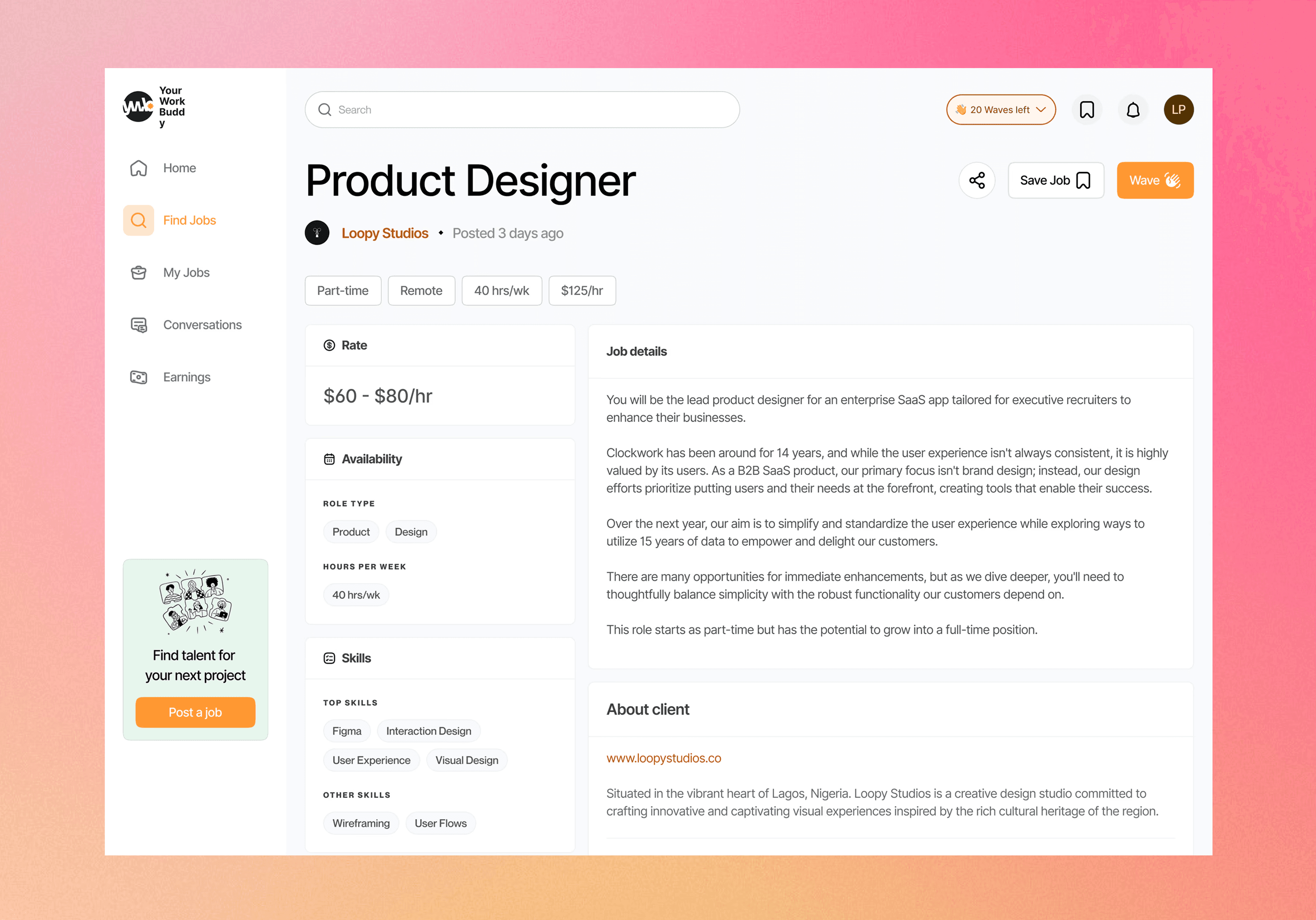
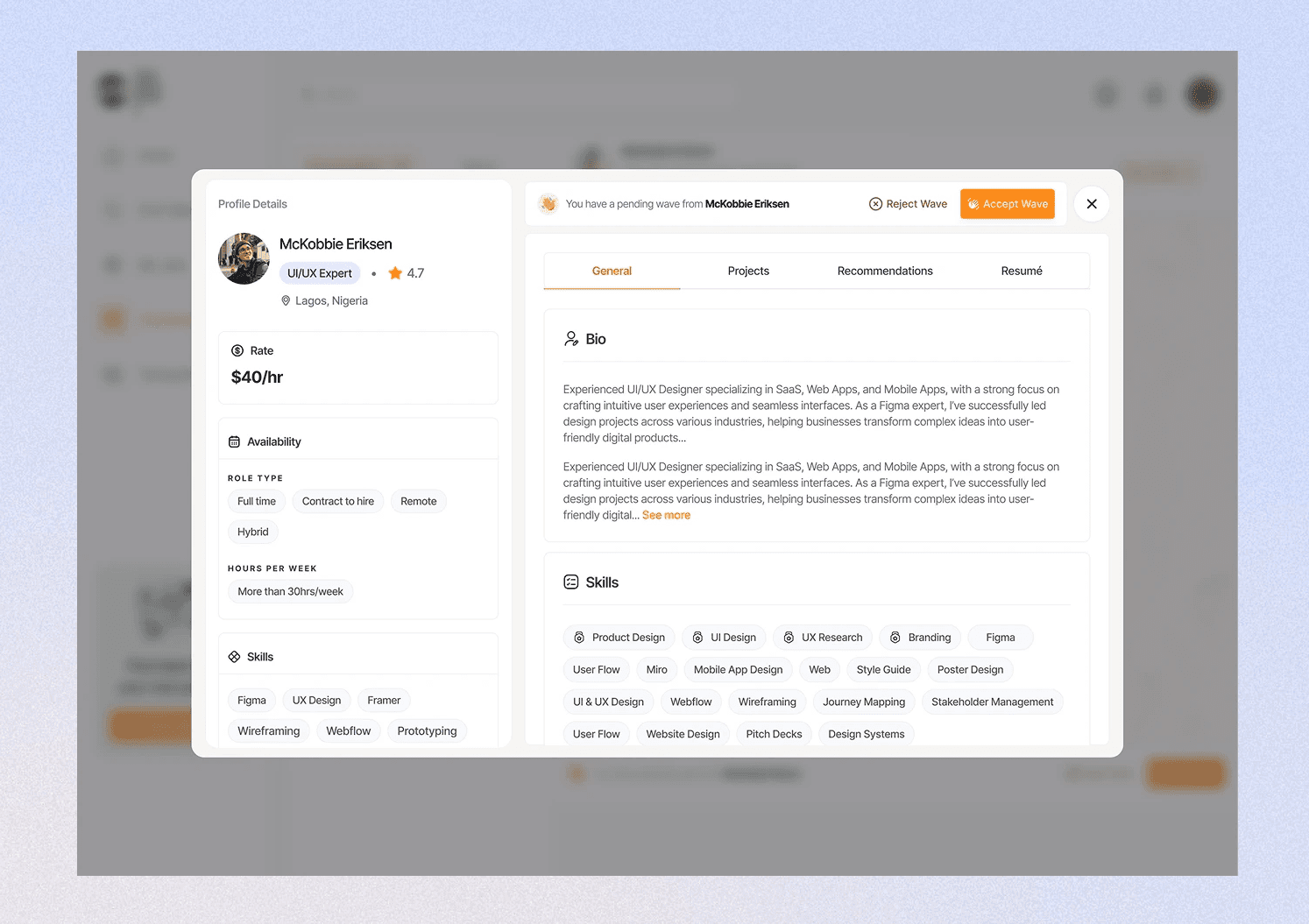
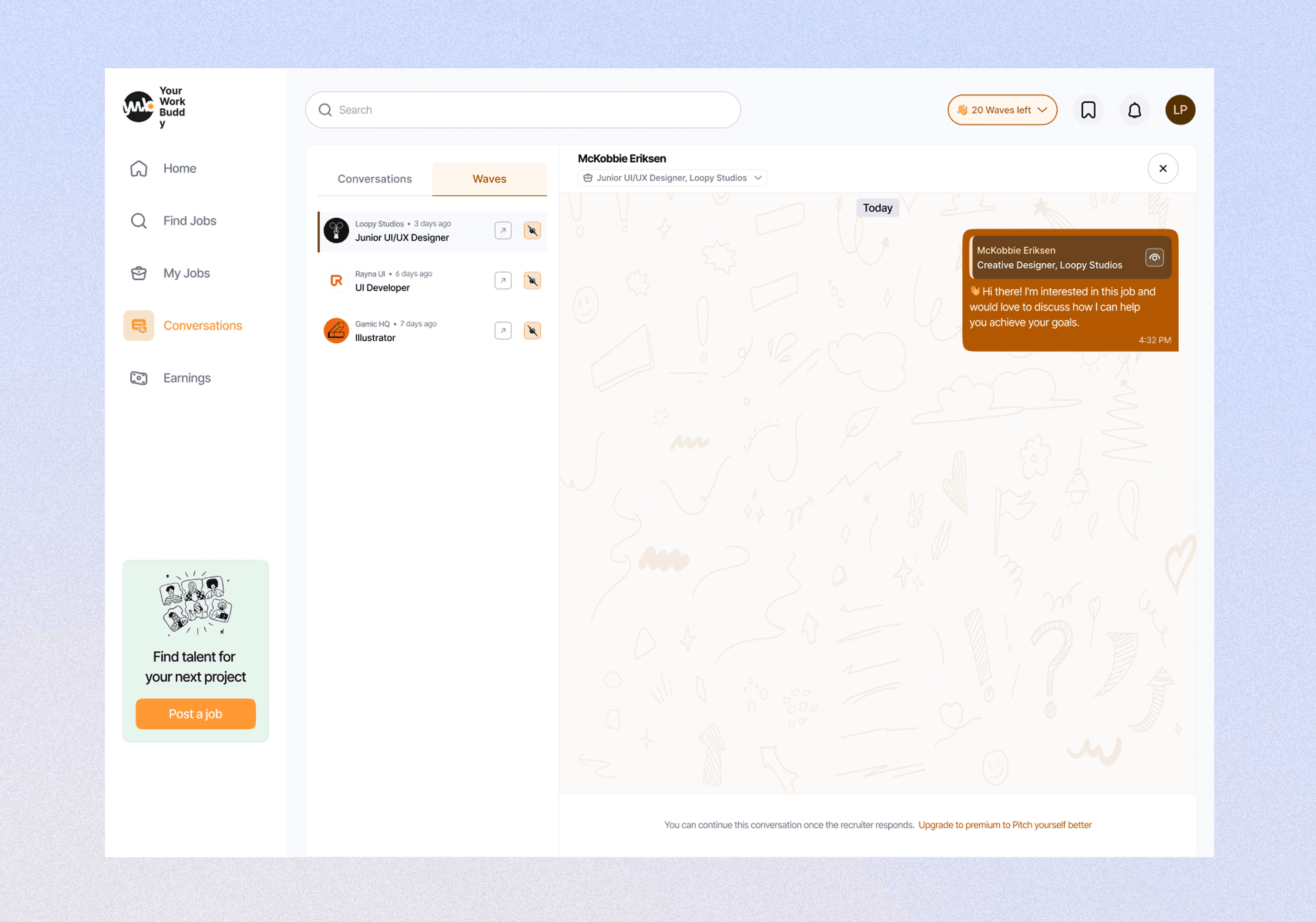
We designed the “Wave” as a lightweight yet meaningful interaction — a signal of interest from a talent to a client.
Talents could send a wave, backed by a concise request profile that highlights their skills and fit.
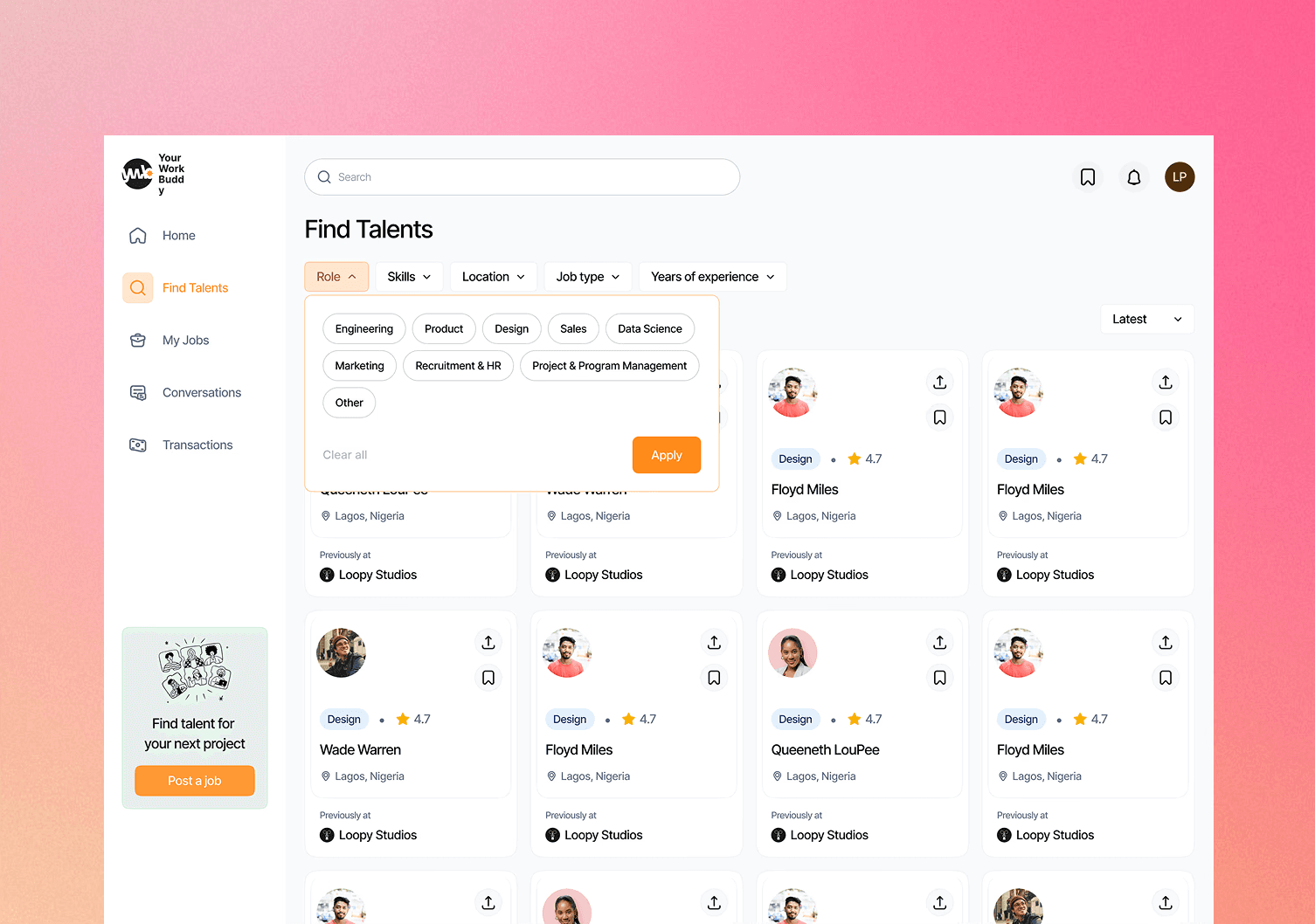
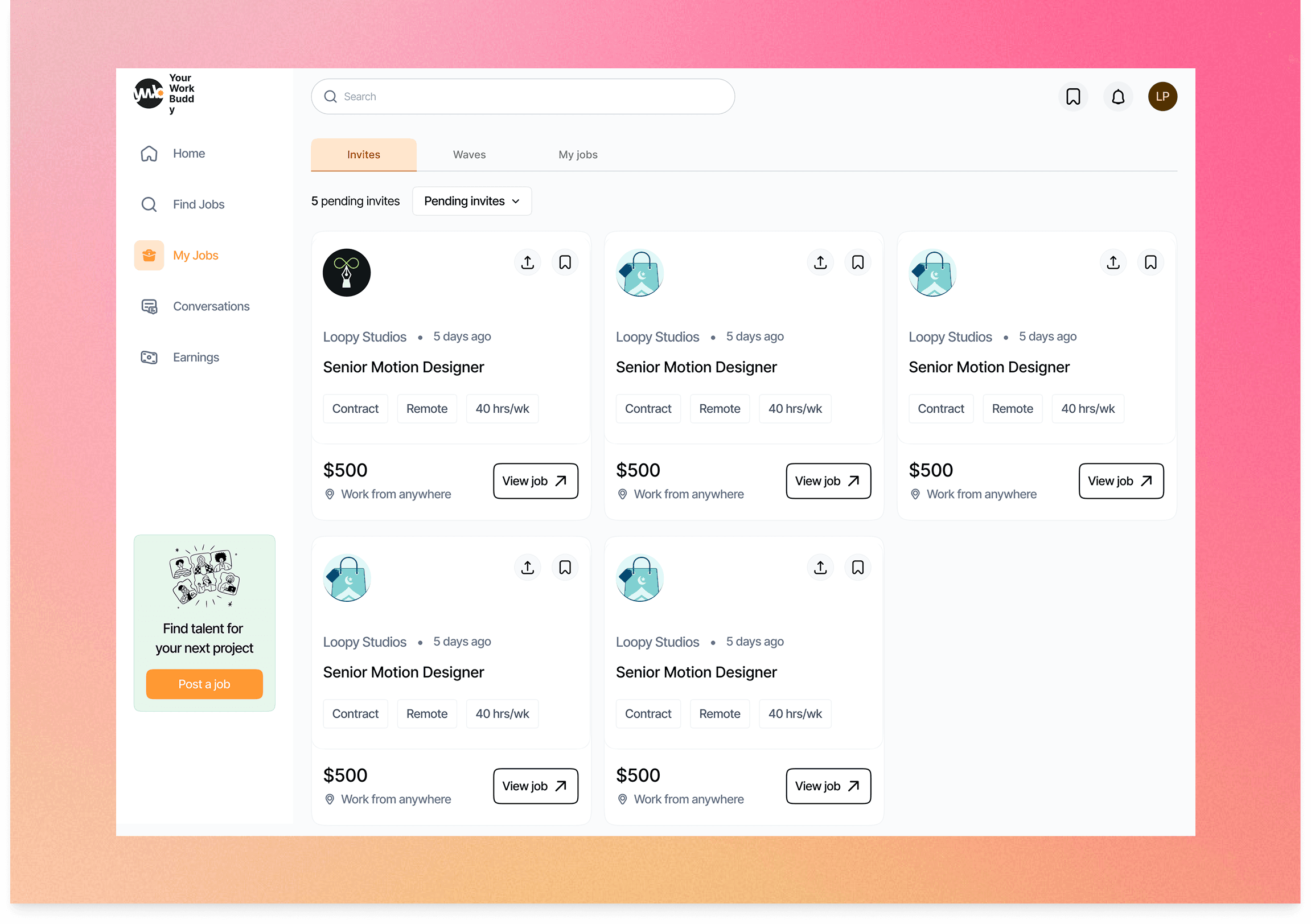
Clients received a clear, structured view of who was waving at them.
The goal wasn't just to match talents and clients, it was to build a system where relationships could grow naturally into projects, the same way conversations in real life grow into opportunities.
Turning Chats into Collaboration
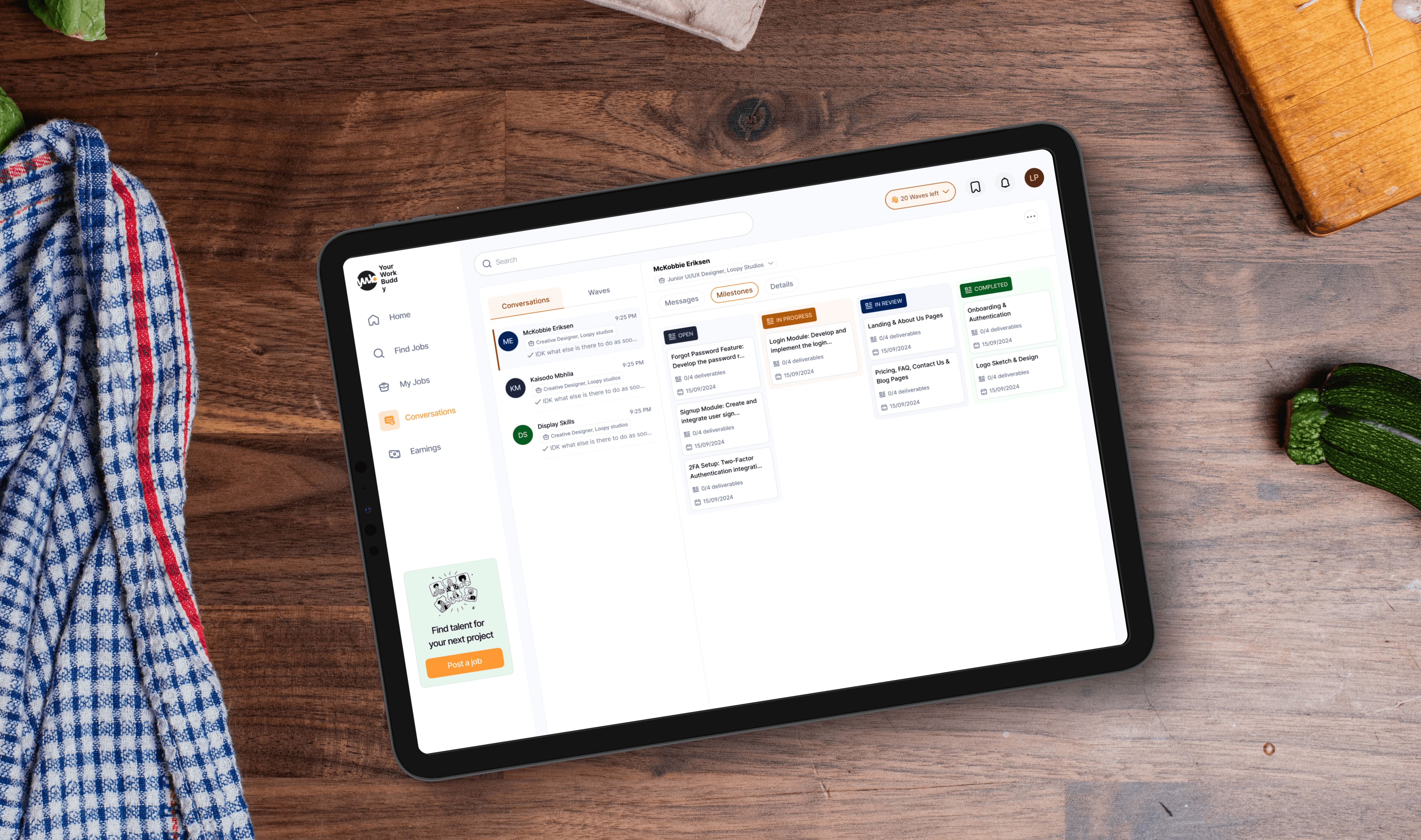
We wanted this chat space to feel instantly familiar like Slack or WhatsApp, yet built for project growth.
Inside this embedded chat interface, talents and clients could:
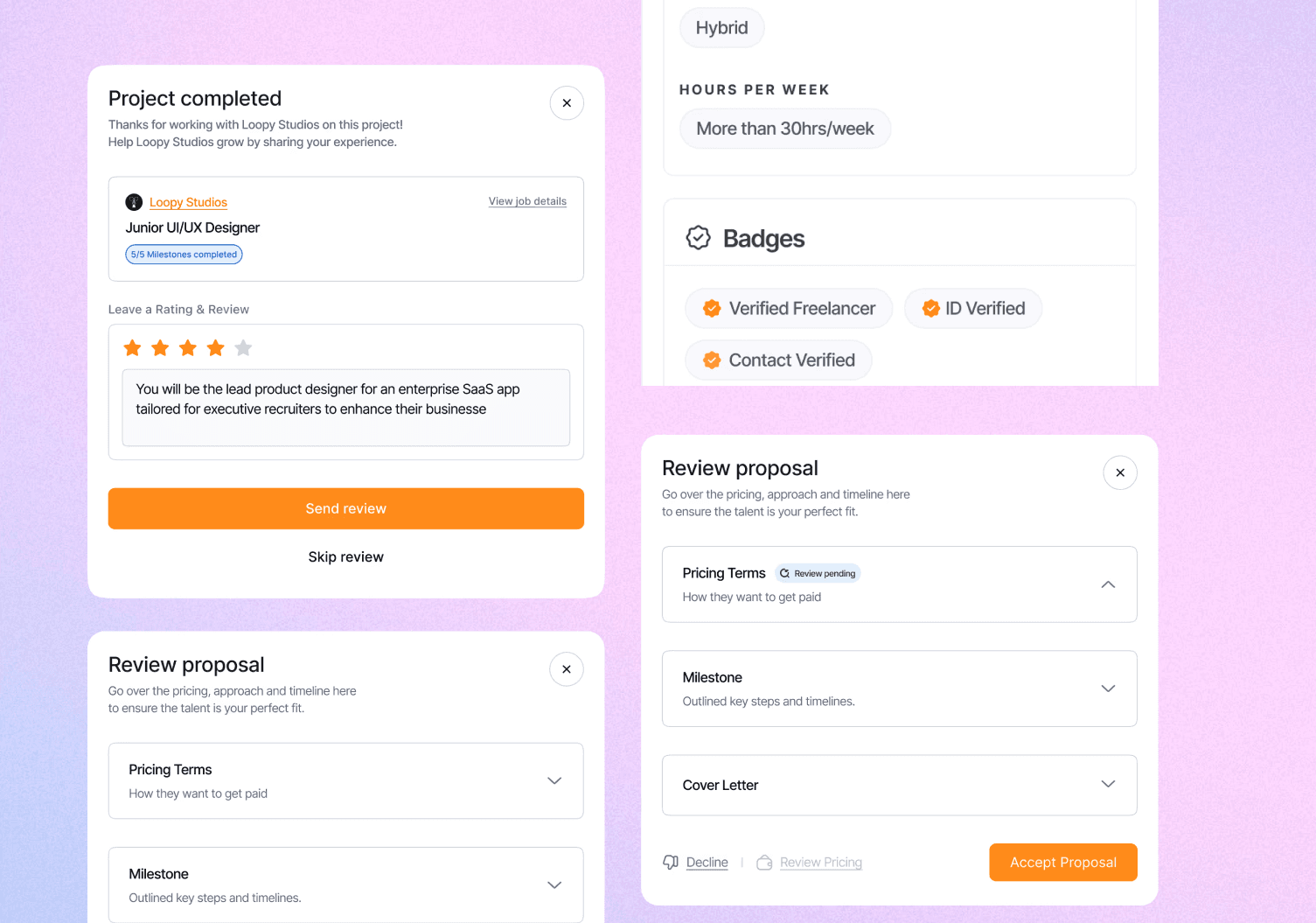
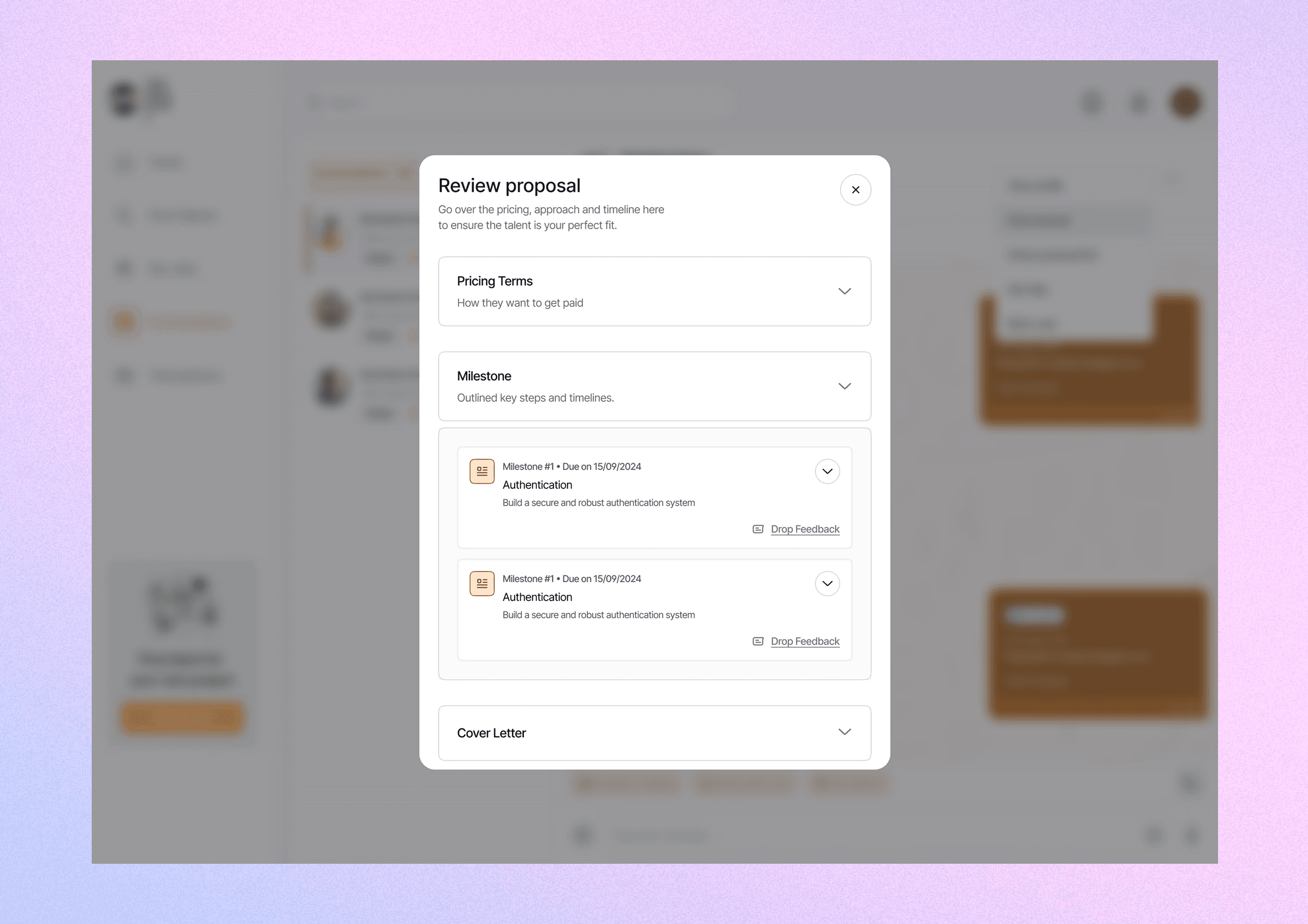
Draft & refine proposals directly in the conversation.
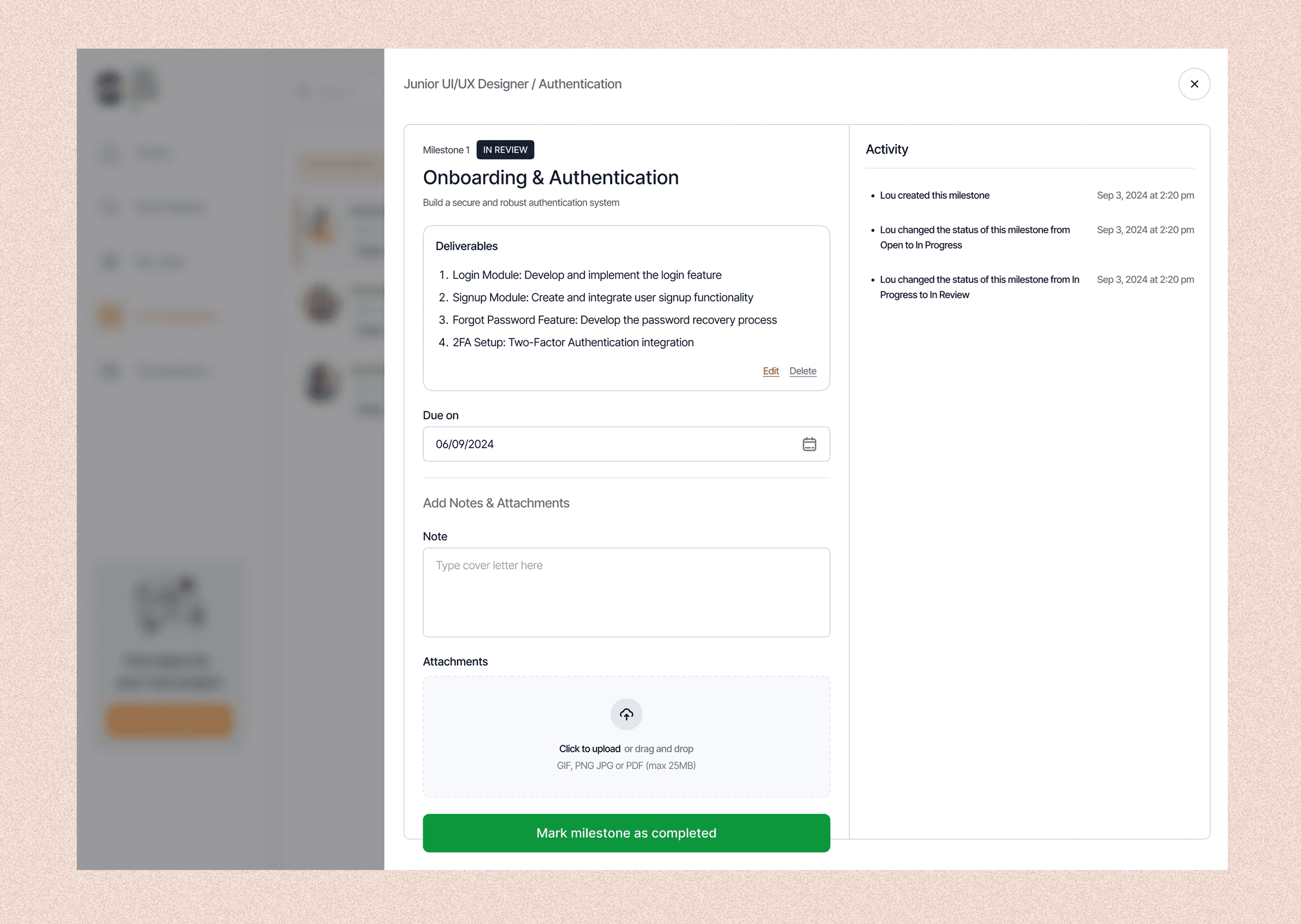
Review and approve milestones without switching tools.
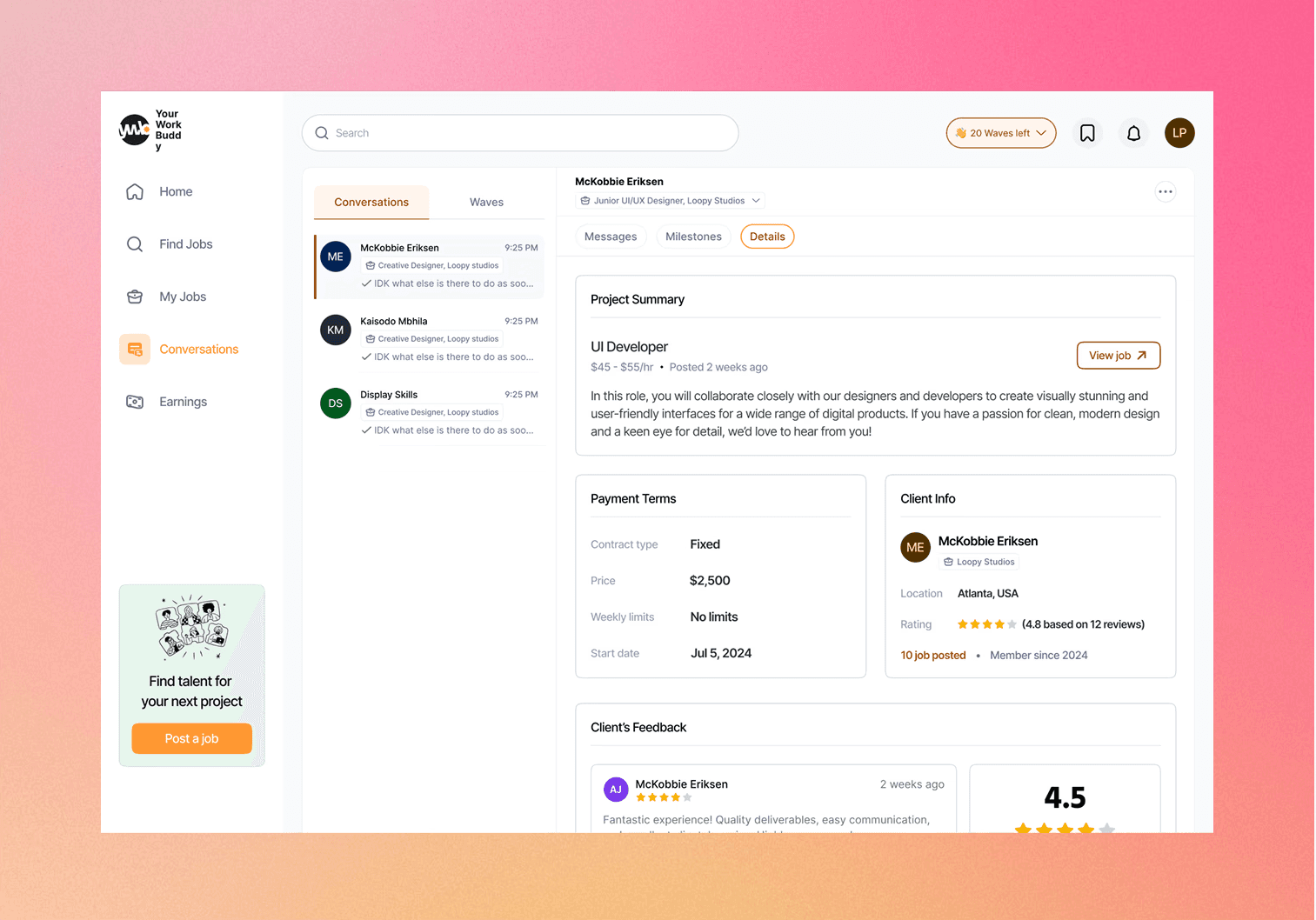
Track project progress in real time, with updates woven into the chat.


The Connected Flow
By tying it all together, the journey looked like this:
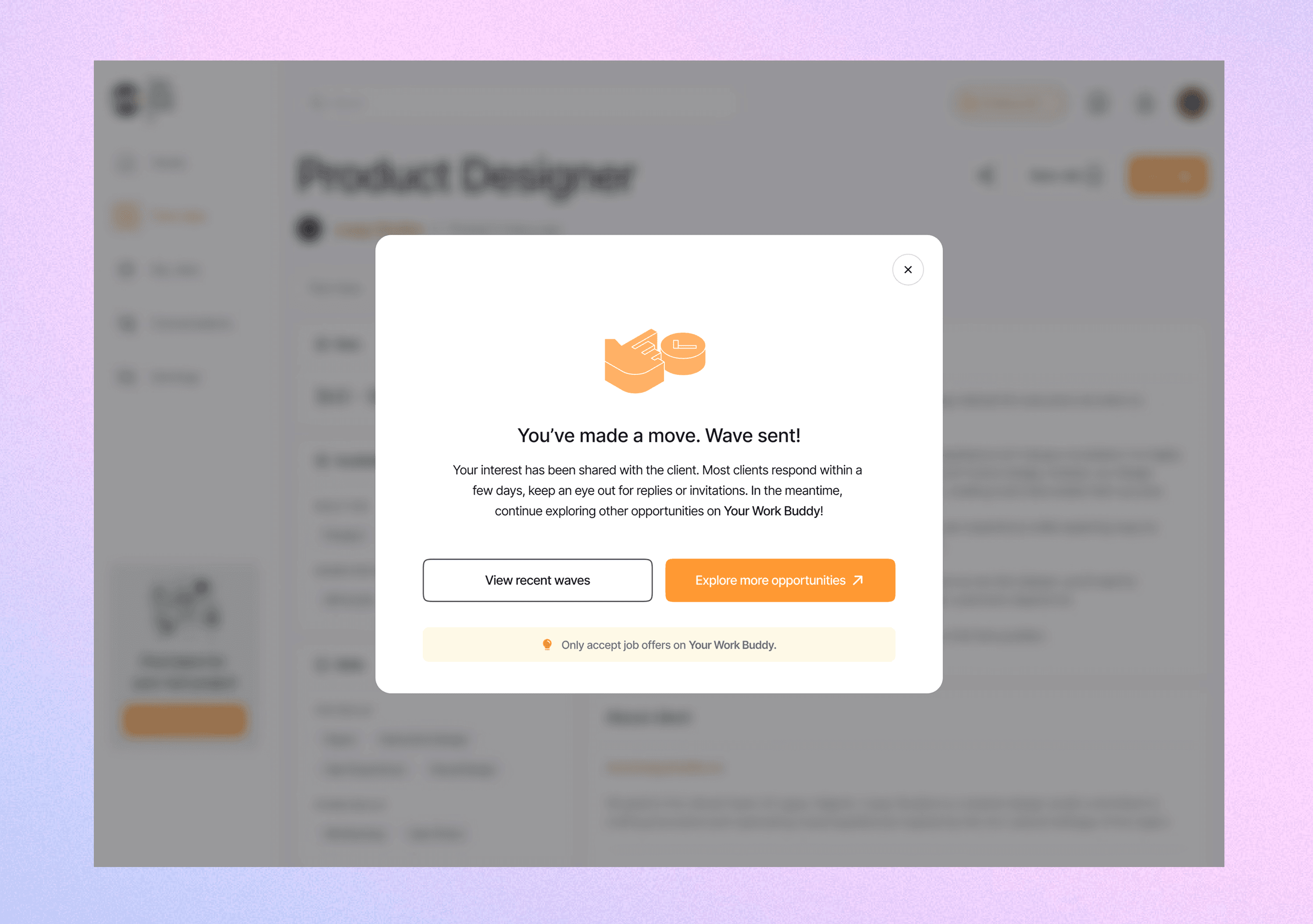
A talent sends a wave → lightweight interest signal.
A client reviews and accepts → trust begins.
Both enter a chat-powered workspace → collaboration kicks off.
Proposals, milestones, and tracking happen in the same space → work becomes seamless.
Inside this space, both talent and client can:
Draft and refine proposals
Review milestones and deliverables
Track project progress without switching tools
Everything happens in one flowing conversation. The chat becomes more than messaging — it's a hub where ideas turn into actions, and actions into results.


Why It Matters
At first glance, sending a Wave might seem like just another interaction in a hiring platform. But it solves two of the biggest emotional gaps in freelance collaboration: uncertainty and trust.
For Clients, finding the right person used to feel like scrolling endlessly through half-finished profiles and guessing who might actually deliver. It was messy, tiring, and full of second-guessing. With Waves, that stress is lifted. Each request comes with clear intent and enough context to help them decide with confidence instead of hesitation.
For Talents, sending out applications often felt like tossing resumes into a black hole with no response, no feedback, just silence. That kind of uncertainty eats away at motivation. Waves flips that around. Now their interest shows up clearly, can be tracked, and gets acknowledged, so they always know where they stand.


Trust through Transparency
Before: Clients often felt overwhelmed or unsure when job requests came in. They couldn’t easily differentiate between serious, qualified talent interest and casual noise.
With the Wave: Each incoming request is packaged with the Talent’s profile, context, and intent, so the client sees exactly who is waving and why.
This transparency removes guesswork and gives clients confidence that they’re making an informed choice.
Accepting a Wave becomes a trustable “yes” because it’s backed by clear, structured information — not vague applications.


Designing for Relationships, Not Just Jobs
Talents applications were being sent not knowing whether their interest was seen, considered, or ignored. That uncertainty was draining
With the Wave: Once sent, the status of the request is trackable — pending, viewed, accepted, or declined.
This gives talents a sense of progress and closure, reducing anxiety and wasted effort.
When accepted, they seamlessly transition into a chat workspace where they can propose, review, and track milestones, instead of juggling multiple disconnected tools.
This balance mattered because trust is the true foundation of work. When both sides feel seen, heard, and in control, collaboration flows naturally. Waves might look simple in the interface, but in practice, they lighten the emotional weight of hiring, transforming it from a process clouded by doubt into one guided by clarity and ease.

Impact Metrics
20%
Increase in client–talent matches within 6 month post launch the wave feature.
70%
Freelancers in user testing reported preferring waves to “burning connects” on other platforms, citing it as “simpler” and “less stressful.”
60%
Adoption of the deliverables dashboard during beta, validating its role as a lightweight project tracker.
2X
Higher engagement from premium users, who were more likely to get accepted by clients due to custom messages.
Your Work Buddy
Bridging Professional Needs with On-Demand Talent
Finding jobs online often feels cold and transactional. YourWorkBuddy’s (YWB) mission was to create a platform that feels like a buddy, someone who smooths the process, reduces friction, and makes work connections feel less daunting.

Year
2025
Project Role
Product Designer
Industry
Job board
Listening to Both Sides
When we spoke to users, we discovered:
Job seekers felt overwhelmed by too many listings, unclear requests, and poor visibility into their applications.
Employers struggled to manage a flood of requests, often losing track of which candidates matched their needs best.
We identified key issues:Lack of trust in freelancers
No structured hiring flow for one-off or part-time jobs
Inconsistent communication and job expectations
The frustration wasn’t about opportunities, it was about clarity and connection.


Carving out a solution
My thinking was simple:
If we could make incoming job requests more transparent for Clients, and more trackable for Talents using a Wave, we’d restore trust and ease on both sides.
Early research showed that both clients and talents felt friction in the current system:
Talents disliked burning "connects" on proposals that never got replies.
Clients felt overwhelmed by low-quality or irrelevant pitches.
We explored how messaging apps and conversational flows create trust and immediacy.
Insights made it clear: to stand out, YourWorkBuddy had to move away from cold proposals and toward warm interactions.
Framing the Hypothesis
The guiding hypothesis behind this project was simple
if talents had a lightweight, meaningful way to express interest in a job, would clients feel less overwhelmed?
If clients had a simple system to review and respond, would trust and confidence increase?
And if both could transition smoothly into structured collaboration, would projects succeed more often?
The vision: a platform that felt less like a job board and more like a workspace where collaborative relationships could grow.


From Waves → Contracts
We designed the “Wave” as a lightweight yet meaningful interaction — a signal of interest from a talent to a client.
Talents could send a wave, backed by a concise request profile that highlights their skills and fit.
Clients received a clear, structured view of who was waving at them.
The goal wasn't just to match talents and clients, it was to build a system where relationships could grow naturally into projects, the same way conversations in real life grow into opportunities.
Turning Chats into Collaboration
We wanted this chat space to feel instantly familiar like Slack or WhatsApp, yet built for project growth.
Inside this embedded chat interface, talents and clients could:
Draft & refine proposals directly in the conversation.
Review and approve milestones without switching tools.
Track project progress in real time, with updates woven into the chat.


The Connected Flow
By tying it all together, the journey looked like this:
A talent sends a wave → lightweight interest signal.
A client reviews and accepts → trust begins.
Both enter a chat-powered workspace → collaboration kicks off.
Proposals, milestones, and tracking happen in the same space → work becomes seamless.
Inside this space, both talent and client can:
Draft and refine proposals
Review milestones and deliverables
Track project progress without switching tools
Everything happens in one flowing conversation. The chat becomes more than messaging — it's a hub where ideas turn into actions, and actions into results.


Why It Matters
At first glance, sending a Wave might seem like just another interaction in a hiring platform. But it solves two of the biggest emotional gaps in freelance collaboration: uncertainty and trust.
For Clients, finding the right person used to feel like scrolling endlessly through half-finished profiles and guessing who might actually deliver. It was messy, tiring, and full of second-guessing. With Waves, that stress is lifted. Each request comes with clear intent and enough context to help them decide with confidence instead of hesitation.
For Talents, sending out applications often felt like tossing resumes into a black hole with no response, no feedback, just silence. That kind of uncertainty eats away at motivation. Waves flips that around. Now their interest shows up clearly, can be tracked, and gets acknowledged, so they always know where they stand.


Trust through Transparency
Before: Clients often felt overwhelmed or unsure when job requests came in. They couldn’t easily differentiate between serious, qualified talent interest and casual noise.
With the Wave: Each incoming request is packaged with the Talent’s profile, context, and intent, so the client sees exactly who is waving and why.
This transparency removes guesswork and gives clients confidence that they’re making an informed choice.
Accepting a Wave becomes a trustable “yes” because it’s backed by clear, structured information — not vague applications.


Designing for Relationships, Not Just Jobs
Talents applications were being sent not knowing whether their interest was seen, considered, or ignored. That uncertainty was draining
With the Wave: Once sent, the status of the request is trackable — pending, viewed, accepted, or declined.
This gives talents a sense of progress and closure, reducing anxiety and wasted effort.
When accepted, they seamlessly transition into a chat workspace where they can propose, review, and track milestones, instead of juggling multiple disconnected tools.
This balance mattered because trust is the true foundation of work. When both sides feel seen, heard, and in control, collaboration flows naturally. Waves might look simple in the interface, but in practice, they lighten the emotional weight of hiring, transforming it from a process clouded by doubt into one guided by clarity and ease.

Impact Metrics
20%
Increase in client–talent matches within 6 month post launch the wave feature.
70%
Freelancers in user testing reported preferring waves to “burning connects” on other platforms, citing it as “simpler” and “less stressful.”
60%
Adoption of the deliverables dashboard during beta, validating its role as a lightweight project tracker.
2X
Higher engagement from premium users, who were more likely to get accepted by clients due to custom messages.
Your Work Buddy
Bridging Professional Needs with On-Demand Talent
Finding jobs online often feels cold and transactional. YourWorkBuddy’s (YWB) mission was to create a platform that feels like a buddy, someone who smooths the process, reduces friction, and makes work connections feel less daunting.

Year
2025
Project Role
Product Designer
Industry
Job board
Listening to Both Sides
When we spoke to users, we discovered:
Job seekers felt overwhelmed by too many listings, unclear requests, and poor visibility into their applications.
Employers struggled to manage a flood of requests, often losing track of which candidates matched their needs best.
We identified key issues:Lack of trust in freelancers
No structured hiring flow for one-off or part-time jobs
Inconsistent communication and job expectations
The frustration wasn’t about opportunities, it was about clarity and connection.


Carving out a solution
My thinking was simple:
If we could make incoming job requests more transparent for Clients, and more trackable for Talents using a Wave, we’d restore trust and ease on both sides.
Early research showed that both clients and talents felt friction in the current system:
Talents disliked burning "connects" on proposals that never got replies.
Clients felt overwhelmed by low-quality or irrelevant pitches.
We explored how messaging apps and conversational flows create trust and immediacy.
Insights made it clear: to stand out, YourWorkBuddy had to move away from cold proposals and toward warm interactions.
Framing the Hypothesis
The guiding hypothesis behind this project was simple
if talents had a lightweight, meaningful way to express interest in a job, would clients feel less overwhelmed?
If clients had a simple system to review and respond, would trust and confidence increase?
And if both could transition smoothly into structured collaboration, would projects succeed more often?
The vision: a platform that felt less like a job board and more like a workspace where collaborative relationships could grow.


From Waves → Contracts
We designed the “Wave” as a lightweight yet meaningful interaction — a signal of interest from a talent to a client.
Talents could send a wave, backed by a concise request profile that highlights their skills and fit.
Clients received a clear, structured view of who was waving at them.
The goal wasn't just to match talents and clients, it was to build a system where relationships could grow naturally into projects, the same way conversations in real life grow into opportunities.
Turning Chats into Collaboration
We wanted this chat space to feel instantly familiar like Slack or WhatsApp, yet built for project growth.
Inside this embedded chat interface, talents and clients could:
Draft & refine proposals directly in the conversation.
Review and approve milestones without switching tools.
Track project progress in real time, with updates woven into the chat.


The Connected Flow
By tying it all together, the journey looked like this:
A talent sends a wave → lightweight interest signal.
A client reviews and accepts → trust begins.
Both enter a chat-powered workspace → collaboration kicks off.
Proposals, milestones, and tracking happen in the same space → work becomes seamless.
Inside this space, both talent and client can:
Draft and refine proposals
Review milestones and deliverables
Track project progress without switching tools
Everything happens in one flowing conversation. The chat becomes more than messaging — it's a hub where ideas turn into actions, and actions into results.


Why It Matters
At first glance, sending a Wave might seem like just another interaction in a hiring platform. But it solves two of the biggest emotional gaps in freelance collaboration: uncertainty and trust.
For Clients, finding the right person used to feel like scrolling endlessly through half-finished profiles and guessing who might actually deliver. It was messy, tiring, and full of second-guessing. With Waves, that stress is lifted. Each request comes with clear intent and enough context to help them decide with confidence instead of hesitation.
For Talents, sending out applications often felt like tossing resumes into a black hole with no response, no feedback, just silence. That kind of uncertainty eats away at motivation. Waves flips that around. Now their interest shows up clearly, can be tracked, and gets acknowledged, so they always know where they stand.


Trust through Transparency
Before: Clients often felt overwhelmed or unsure when job requests came in. They couldn’t easily differentiate between serious, qualified talent interest and casual noise.
With the Wave: Each incoming request is packaged with the Talent’s profile, context, and intent, so the client sees exactly who is waving and why.
This transparency removes guesswork and gives clients confidence that they’re making an informed choice.
Accepting a Wave becomes a trustable “yes” because it’s backed by clear, structured information — not vague applications.


Designing for Relationships, Not Just Jobs
Talents applications were being sent not knowing whether their interest was seen, considered, or ignored. That uncertainty was draining
With the Wave: Once sent, the status of the request is trackable — pending, viewed, accepted, or declined.
This gives talents a sense of progress and closure, reducing anxiety and wasted effort.
When accepted, they seamlessly transition into a chat workspace where they can propose, review, and track milestones, instead of juggling multiple disconnected tools.
This balance mattered because trust is the true foundation of work. When both sides feel seen, heard, and in control, collaboration flows naturally. Waves might look simple in the interface, but in practice, they lighten the emotional weight of hiring, transforming it from a process clouded by doubt into one guided by clarity and ease.

Impact Metrics
20%
Increase in client–talent matches within 6 month post launch the wave feature.
70%
Freelancers in user testing reported preferring waves to “burning connects” on other platforms, citing it as “simpler” and “less stressful.”
60%
Adoption of the deliverables dashboard during beta, validating its role as a lightweight project tracker.
2X
Higher engagement from premium users, who were more likely to get accepted by clients due to custom messages.